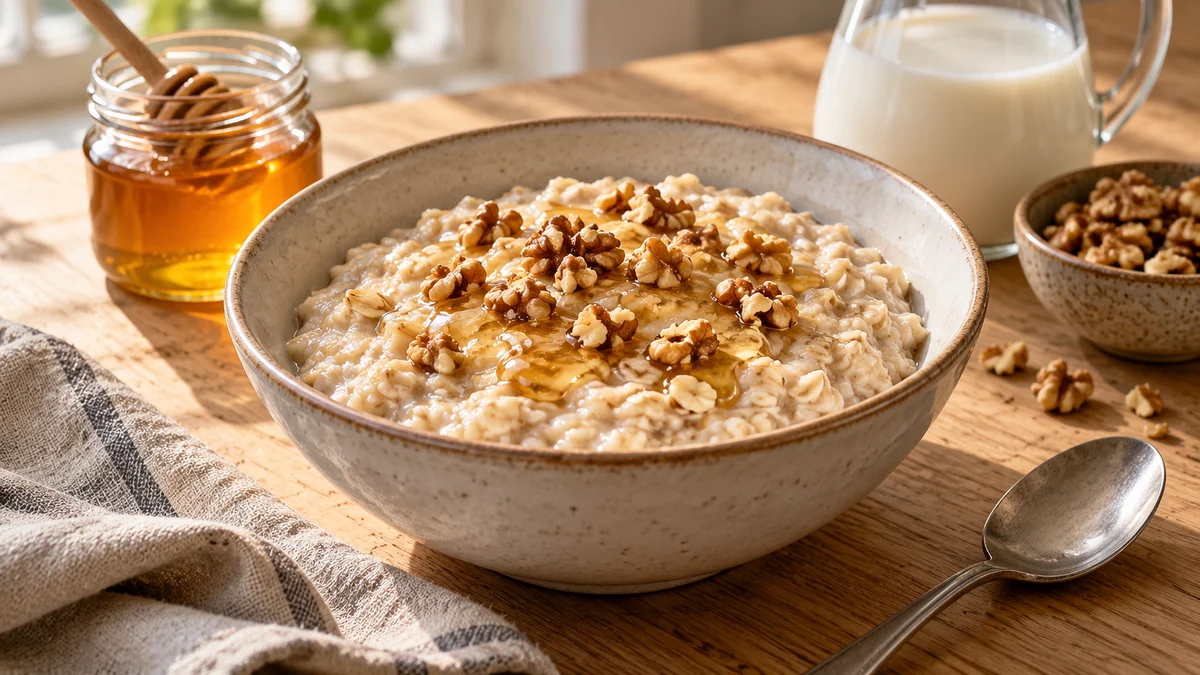
Oatmeal with honey and walnuts comes together in one small saucepan with a few easy-to-measure ingredients. Oats form the base, milk gives it a creamier texture, and honey and walnuts add sweetness and crunch. You do not need a ready-made sweetened mix, extra sugar, or special equipment for this recipe.
Below you will find measurements for two servings, cooking instructions, and tips for adjusting the consistency. If you prefer oatmeal made with water, the basic method stays the same. Cooking time depends on the oats, so check the instructions on your package too.
Contents
Oatmeal with honey: ingredients and preparation time
Yield: 2 servings
Preparation: about 5 minutes
Cooking: approximately 5–8 minutes for regular rolled oats
Total: about 15 minutes, including a short rest
| Ingredient | Amount for two servings |
|---|---|
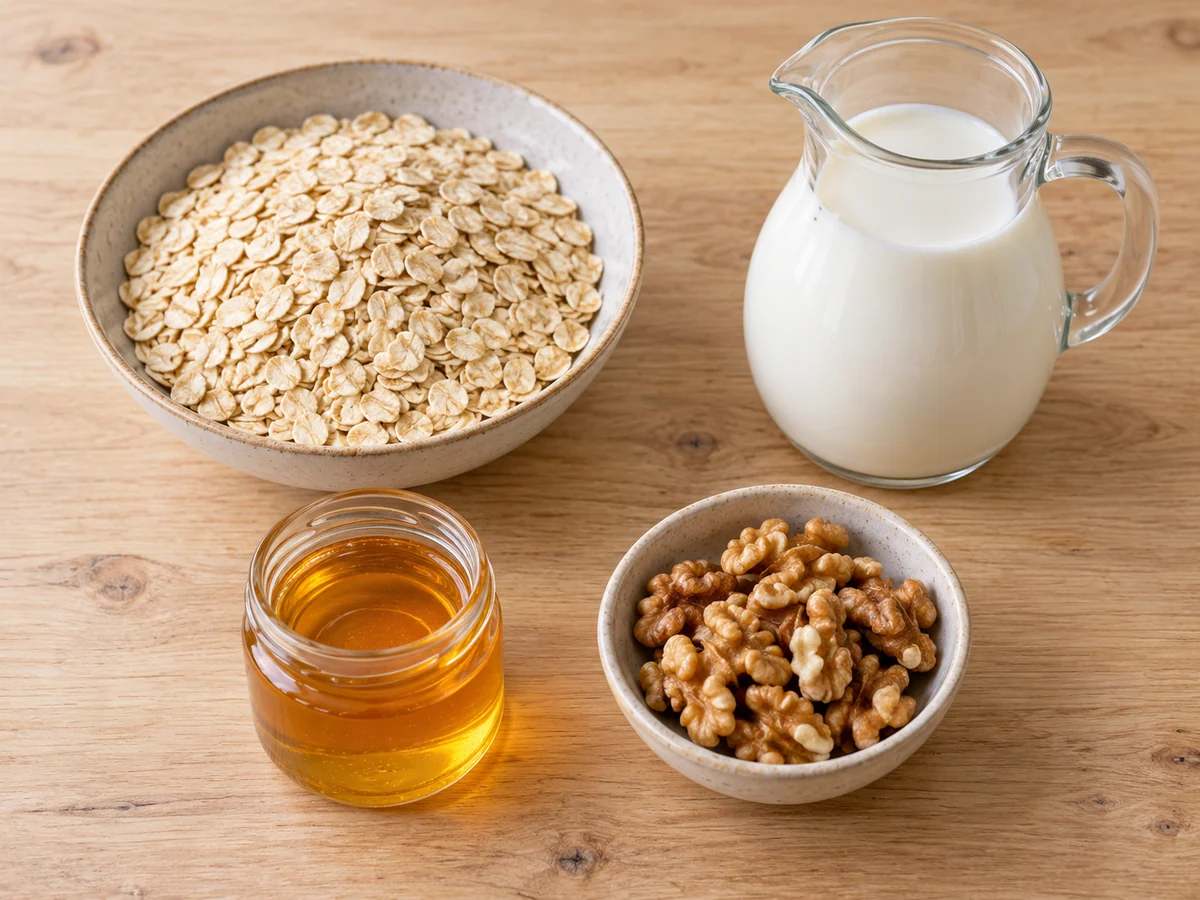
| Plain rolled oats, with no added sugar | 100 g |
| Milk | 500 ml |
| Honey | 2 level teaspoons, approximately 14 g in total |
| Shelled walnuts | 30 g |
For a thinner consistency, have another 50–100 ml of milk or water ready and add it gradually as needed. This extra liquid is for adjusting the texture, rather than a required ingredient.
Estimated energy: approximately 450 kcal per serving (half of the basic recipe). The estimate uses 100 g plain rolled oats, 500 ml cow’s milk with 2.8% fat, 14 g honey, and 30 g walnuts, divided into two servings. Optional extra milk, fruit, and additional honey are not included. Actual values depend on the ingredient labels; replacing milk with water or a plant-based drink changes the result.
Calculation sources: nutrition labels and data from Post Consumer Brands, Imlek, National Honey Board and California Walnuts. This is a calculated estimate, not a laboratory analysis of the finished dish.
Measure the honey to begin with, then taste the cooked oatmeal before adding more. More honey increases both sweetness and sugar intake. To understand the difference, read our guide to honey instead of sugar and how much to use.
Which oats to choose and how much liquid to add
For a breakfast such as oatmeal with honey, use plain rolled oats. Thinner flakes may soften faster, while larger flakes retain more texture. Instant mixes and steel-cut oats are different products: their cooking times and liquid requirements may differ from this method.
Start with 100 g of oats and 500 ml of liquid. This is a practical starting point you can adapt to your oats and preferred consistency. Do not confuse it with a volume ratio: grams of oats and milliliters of milk are different measurements.
For two smaller servings, reduce the ingredients proportionally. For one serving, use 50 g of oats, 250 ml of milk, one level teaspoon of honey, and 15 g of walnuts. You do not need to halve the cooking time: check how well the oats have softened.
How to make oatmeal with honey and walnuts
- Prepare the walnuts. Check for pieces of shell and chop the nuts into smaller pieces. Set them aside until the end.
- Heat the milk. Pour 500 ml into a small, heavy-bottomed saucepan. Heat until it starts to simmer gently, watching so it does not boil over.
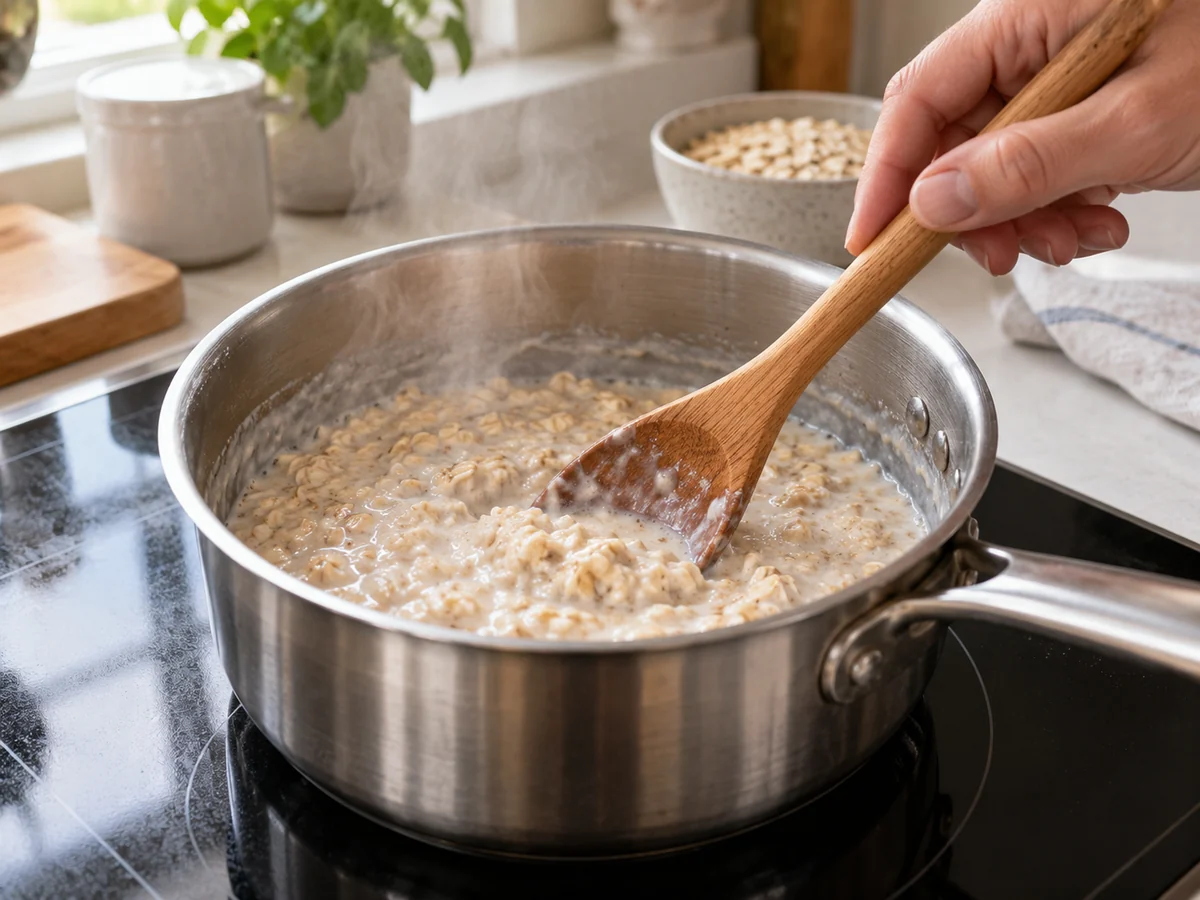
- Add the oats. Stir in 100 g of oats and lower the heat. The oatmeal should simmer gently.
- Cook, stirring regularly. Cook for approximately 5–8 minutes, or according to the package, until the oats soften. Stir frequently, especially along the bottom of the pan. If the mixture gets too thick before the oats are soft, add a little of the extra liquid.
- Let it rest briefly. Remove the saucepan from the heat and wait about two minutes. The oatmeal will thicken further, so now decide whether it needs a little more milk.
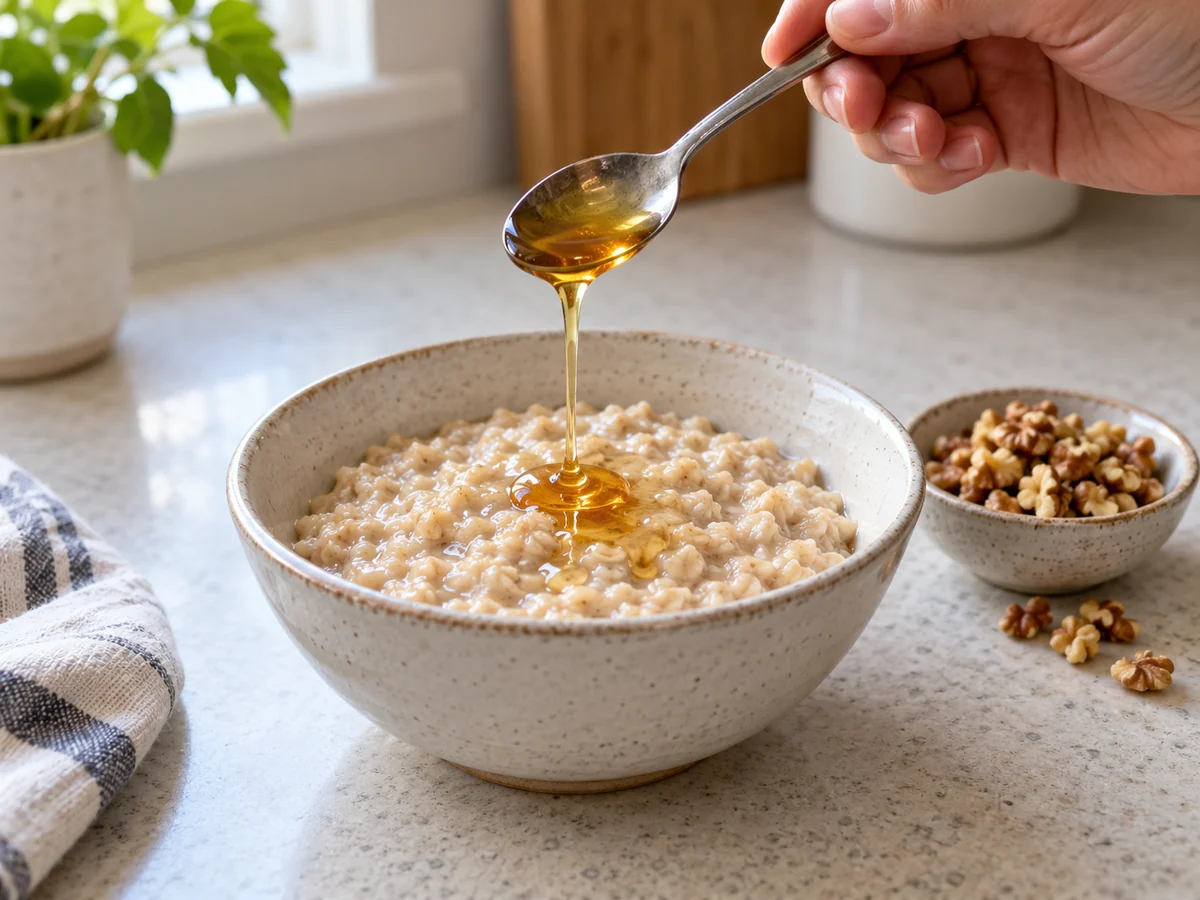
- Add the honey and walnuts. Divide between two bowls. When comfortably warm to eat, stir one level teaspoon of honey into each serving and top each with half the walnuts.
For regular oats, Quaker describes a short stovetop cooking method of about five minutes. Our range allows for differences between products and your preferred texture. The manufacturer’s instructions and your package are more useful than following a timer blindly.
When to add honey and which honey to choose
In this recipe, add honey after cooking. This makes sweetness easier to control, and there is no need to boil the honey with the milk. You do not need to measure a special temperature for adding it: wait until the oatmeal is comfortably warm to serve.
Choose acacia honey for a milder taste or wildflower honey for a more pronounced aroma. Our guide to acacia honey vs wildflower honey explains the differences. This is a matter of taste, rather than a therapeutic advantage of one honey over another.
You can use crystallized honey too: stir a small amount into the warm oatmeal. There is no need to warm the whole jar beforehand for this recipe.
Variations with water or plant-based drinks
Oatmeal with honey made with water: replace the milk with 500 ml of water. The taste will be milder and the texture different. For an in-between option, use 250 ml of milk and 250 ml of water.
Using a plant-based drink: use 500 ml of an unsweetened drink you normally cook with. Check the label, as composition and behavior when heated vary. Oat, soy, and almond drinks are not nutritionally identical.
Adding fruit: optionally add a few banana slices or a little chopped apple when serving. Fruit is not part of the basic recipe and is not necessary for it to work. When adding sweet fruit, taste before increasing the honey.
If you enjoy this combination beyond breakfast, read how to prepare and store honey with walnuts. That guide covers a different preparation: oatmeal has different storage requirements because it contains liquid.
How to keep oatmeal creamy without scorching
- Avoid high heat. A gentle simmer is easier to control, and milk and oats are less likely to stick to the bottom.
- Stir along the bottom too. The surface can still look fluid while a thick layer forms underneath.
- Check the thickness after a short rest. Oats continue absorbing liquid after you take the pan off the heat.
- Add extra liquid gradually. It is easier to thin oatmeal with small additions than to correct a mixture that is too runny.
- Add walnuts when serving. This helps preserve their crunch.
If the oatmeal scorches, do not scrape the burnt layer into the rest of the food. If it is too thick, stir in a little milk or water. If it is too thin, cook a little longer, stirring, and allow it to rest.
Storing and reheating oatmeal
The simplest approach is to make only what you will eat straight away. For advance preparation, it is more practical to store the cooked base without honey, walnuts, or fruit, then add the toppings when serving.
Transfer leftovers to a clean, small, shallow container and refrigerate within two hours of preparation. In very hot conditions above approximately 32 °C (90 °F), the limit is one hour. Do not leave the saucepan on the counter until completely cool. Keep the refrigerator at 4 °C (40 °F) or below.
For the best texture, eat the oatmeal the next day. The general USDA recommendation for properly refrigerated cooked leftovers is three to four days; this is not a specific shelf-life guarantee for every batch of oatmeal. If the food has been left out too long, do not rely on its smell as proof of safety or try to make it safe by reheating.
Reheat only the serving you will eat. Add a little milk or water and heat evenly throughout, stirring. The recommended reheating temperature for leftovers is 74 °C (165 °F). In a microwave, use a suitable container and stir during heating. See the USDA guide to leftovers and FDA advice on safe food handling for storage and reheating guidance.
Allergens and important precautions
The basic recipe contains milk and walnuts. If you are allergic to either, do not use it: any substitute must suit the particular allergy, rather than just your taste. If you need to avoid gluten, choose oats clearly labeled gluten-free and check the other ingredients. See the FDA explanation of gluten-free labeling for information about oats.
Do not give honey to children younger than 12 months, including honey added to food. This recommendation is stated by the CDC. This recipe with chopped walnuts has not been specifically adapted for young children.
Frequently asked questions
Can I make oatmeal without milk?
Yes. Use water or a suitable unsweetened plant-based drink. Start with the same amount of liquid and adjust the consistency while cooking. The flavor and nutritional composition depend on your chosen substitute.
Why does oatmeal thicken after cooking?
Oats continue to absorb liquid as the oatmeal stands. Leave it slightly looser toward the end of cooking and, if needed, stir in a little more milk or water before serving.
Can I use a prepared honey-and-walnut mixture?
You can add it when serving, provided all its ingredients suit you. In that case, do not automatically add the full amounts of honey and walnuts from this recipe as well. Mixtures have different proportions, so adjust the quantity to taste.
Is this the same as overnight oats?
No. Here, the oats are cooked and served warm. Overnight oats are made by soaking in the refrigerator and require a different method; the times in this recipe do not apply to them.
A simple breakfast you can adapt
To make oatmeal with honey and walnuts as thick and sweet as you like, begin with the basic measurements, watch the texture, and add honey and walnuts at the end.
To explore honey for this breakfast, visit our honey shop. For a different homemade recipe with honey, try our honey cake with almonds.