Honey and diabetes often come up together in a practical question: can you eat honey, and is it a better choice than sugar? Honey contains sugars and can raise blood sugar. It needs to be counted in your carbohydrate intake, even when it is natural.
That does not mean every person with diabetes must automatically avoid every gram of honey. Whether a portion fits depends on your agreed eating plan, treatment and blood sugar monitoring. This guide explains portions and labels; it does not prescribe a personal daily allowance or a medication dose.
Contents
How honey affects blood sugar
Honey is not a carbohydrate-free sweetener. According to Mayo Clinic’s explanation of honey and diabetes, replacing sugar with honey generally offers no advantage in a diabetes eating plan: both affect blood sugar.
If you use less sweetener because you prefer its flavour, you have changed the portion. You have not made honey a food that no longer needs to be counted. The same applies to honey dissolved in water or tea: dissolving it does not remove its sugars.
Diabetes UK includes the sugars in honey among free sugars. A recipe made “without white sugar” is therefore not sugar-free if it contains honey. For general cooking and sweetening differences, see honey instead of sugar; with diabetes, your personal plan also matters.
Honey and diabetes: counting carbohydrates in a portion
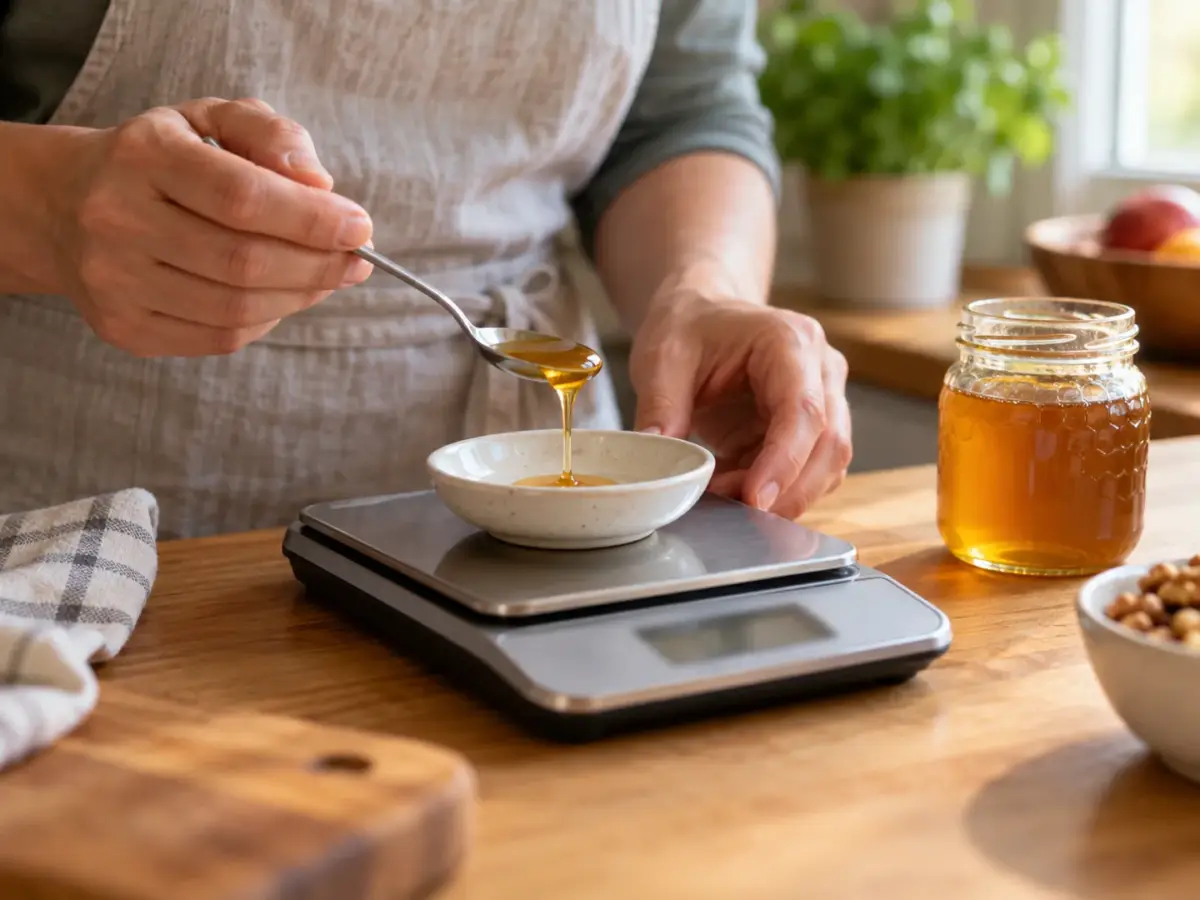
For a practical calculation, check the carbohydrate figure and what it refers to: 100 g of food or a stated serving. Then weigh the amount you will actually eat. “A teaspoon” is less precise if you sometimes use a level spoon and sometimes a heaped one.
Carbohydrates in a portion = portion weight × carbohydrates per 100 g ÷ 100.
A calculation example, not a recommended portion
Suppose, only to demonstrate the calculation, that a product label gives 80 g of carbohydrate per 100 g. The table uses that hypothetical figure; it is not an analysis of our honey or advice about how much you should eat.
| Weight used in this example | Calculation | Carbohydrates |
|---|---|---|
| 5 g | 5 × 80 ÷ 100 | 4 g |
| 10 g | 10 × 80 ÷ 100 | 8 g |
| 15 g | 15 × 80 ÷ 100 | 12 g |
For a real product, replace 80 with its label value or reliable composition data. If that information is missing, ask the producer or use an appropriate source in discussion with your healthcare professional. Our guide to honey calories, nutrition and portions provides a broader introduction.
Do not count the same figure twice
On labels that show “of which sugars,” that figure is part of the stated carbohydrate amount, rather than an extra amount to add again. The American Diabetes Association’s carbohydrate-counting guide emphasises the amount of food and its carbohydrate content. Label formats and the way fibre is listed differ between markets, so ask your team how to read local labels within the counting system you use.
How much honey can fit into an eating plan?
There is no teaspoon or number of grams that is automatically suitable for everyone. The ADA explains that there is no universal carbohydrate amount for each meal; needs and the timing of intake are individual.
The question is not just how much honey is on your spoon. If you add it to breakfast, carbohydrates from the rest of the meal also count. Replacing another sweetener and adding honey to an unchanged meal are two different calculations.
Before discussing whether honey fits your plan, gather information that can make the conversation more useful:
- What you usually eat with honey, and in what quantities.
- The weighed amount of honey you would like to use.
- The eating plan and treatment you already follow.
- Your blood sugar readings, taken according to your agreed monitoring schedule.
Do not use a food calculation to work out a new insulin dose or change your medicine on your own. Counting food provides information for following the plan you have already agreed with your healthcare team.
Does the type of honey change the rules?
Acacia, wildflower, raw or organic honey should not be presented as sugar-free or as a substitute for treatment. Differences in flavour, composition and processing do not mean you can leave its carbohydrates out of your calculation.
The word “natural” says little about how a portion fits into your meal. Glycaemic index alone does not determine a personal honey allowance either: you still need to know the portion and monitor blood sugar according to your team’s guidance.
If you are interested in a particular variety’s flavour and properties, see our guide to acacia honey. Its use as a food does not make it a special product for diabetes. Here, honey is a food to account for, rather than a way to lower blood sugar.
Honey in tea, breakfast and packaged foods
When preparing food at home, you can weigh the honey you add. With a packaged food containing honey, check the full nutrition label and your actual serving, rather than just the honey percentage on the front of the pack.
For example, knowing that cereal, a dressing or a snack bar contains honey does not tell you its total carbohydrate contribution. Other ingredients count too. The ADA’s page on reading food labels is a useful starting point for understanding the information on a pack.

For everyday drinks, first consider whether you need to add a sweetener at all. The NIDDK guide to healthy living with diabetes explains that food and drink choices belong within your care plan. Water or a drink without added sweetener does not add carbohydrates from honey.
You do not have to change every ingredient in a meal at once to understand the calculation. Knowing the amounts you used is more helpful than relying on a broad description such as “a healthy breakfast with honey.”
Why honey is mentioned for low blood sugar
Hypoglycaemia means blood sugar is too low. Managing it is a different situation from choosing an everyday sweetener. NIDDK lists honey among sources of fast-acting carbohydrate.
That does not show that honey treats diabetes or justify taking it routinely to prevent low blood sugar. Follow your agreed plan for a low reading, including the appropriate glucose or carbohydrate source, amount and repeat check. Certain medicines that slow carbohydrate digestion require glucose, so honey is not a universal solution.
If someone is unconscious or cannot swallow safely, do not give honey, food or drink by mouth. MedlinePlus describes care for severe hypoglycaemia. Urgent medical help and the prescribed emergency plan are needed, including glucagon if it is available and you know how to use it.
When to review your plan with your healthcare team
Speak with your doctor or dietitian if you often have low or high readings, your treatment changes, or you are unsure how to account for carbohydrates. Consider readings alongside food, activity and treatment, rather than treating them as a test of whether one jar of honey is good or bad for everyone.
Additional circumstances, such as pregnancy or other conditions, call for an individual discussion. Do not adopt someone else’s “allowed teaspoon” as your own instruction. NIDDK explains diabetes management through an individual care plan.

Take the label, a description of your usual meal and recorded readings to your appointment if you have them. Asking “Can this weighed amount fit into my plan?” is more useful than asking only “Is honey healthy?”
Frequently asked questions
Can people with diabetes eat honey?
The decision is not the same for everyone. If you use honey, its carbohydrates need to be counted and included in your individual eating plan. This article does not set a personal daily amount.
Does acacia honey avoid raising blood sugar?
It should not be presented that way. Acacia honey contains sugars; its floral source is not a reason to leave it out of carbohydrate counting or use it instead of treatment.
Does honey in lukewarm water follow different rules?
Adding water does not remove carbohydrates from the amount of honey you measured. Count how much honey actually went into the drink.
Is one teaspoon every day suitable for everyone?
There is no universal recommendation. Teaspoons can hold different weights, and people’s needs, meals and treatment differ. Check the amount against your own plan rather than someone else’s experience.
Start with a clear calculation
Honey and diabetes call for the same practical starting point: know what the food contains, weigh the portion and account for it in your agreed plan. Natural origin does not make honey sugar-free, and one food does not replace diabetes monitoring or treatment.