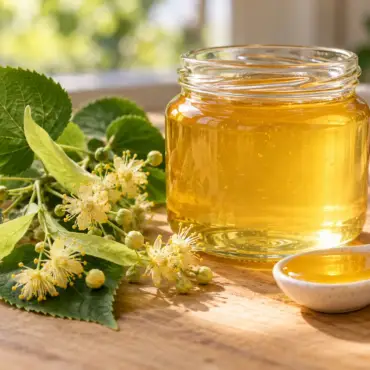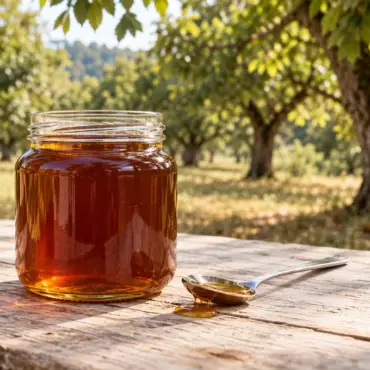
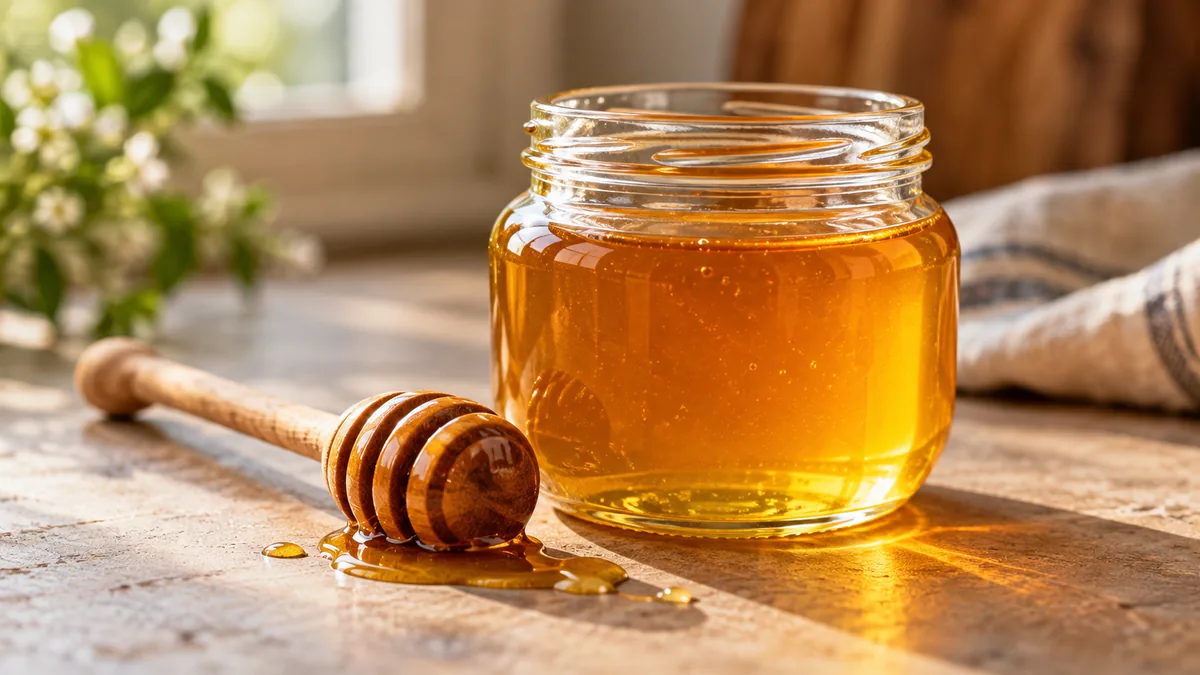
Calories in honey become easier to understand when you compare equal weights and then measure the amount you actually eat. As a general reference, 100 g of honey provides about 304 kcal. A small serving provides fewer calories, but it still contributes to your daily sugar intake. These are average reference values; the label on a particular product is more specific.
Contents
How many calories are in 100 g of honey and a serving?
The USDA FoodData Central record for honey lists approximately 304 kcal and 82.4 g of carbohydrate per 100 g. Applying those figures to weighed portions of 7 g and 20 g gives the following approximate calculations:
| Weighed amount of honey | Energy | Carbohydrate |
|---|---|---|
| 100 g | about 304 kcal | about 82.4 g |
| 7 g — an example of a small level teaspoon | about 21 kcal | about 5.8 g |
| 20 g — an example of a full tablespoon | about 61 kcal | about 16.5 g |
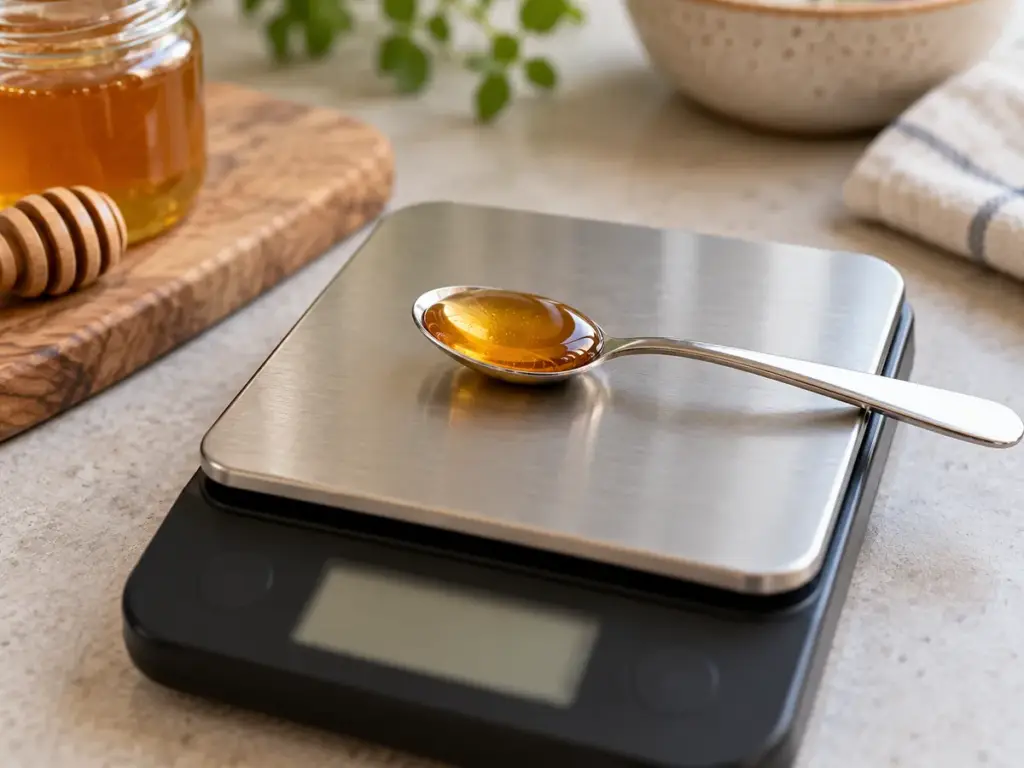
Household spoons are not weighing instruments. Their size, whether they are level or heaped, and the way honey clings to them can change the mass. The table does not mean every teaspoon weighs 7 g or every tablespoon weighs 20 g. For a more useful estimate, place a bowl on a kitchen scale, set it to zero, add honey, and multiply the measured grams by about 3.04 kcal per gram. For example, 12 g works out to roughly 36 kcal.
What are the nutrition facts for honey?
Honey consists mainly of sugars, especially fructose and glucose, along with water and much smaller quantities of other components. The EU Honey Directive describes its composition and quality criteria. The USDA reference values per 100 g include about 82.4 g of carbohydrate, 17.1 g of water, 0.3 g of protein, and virtually no fat. Composition varies naturally between samples and products.
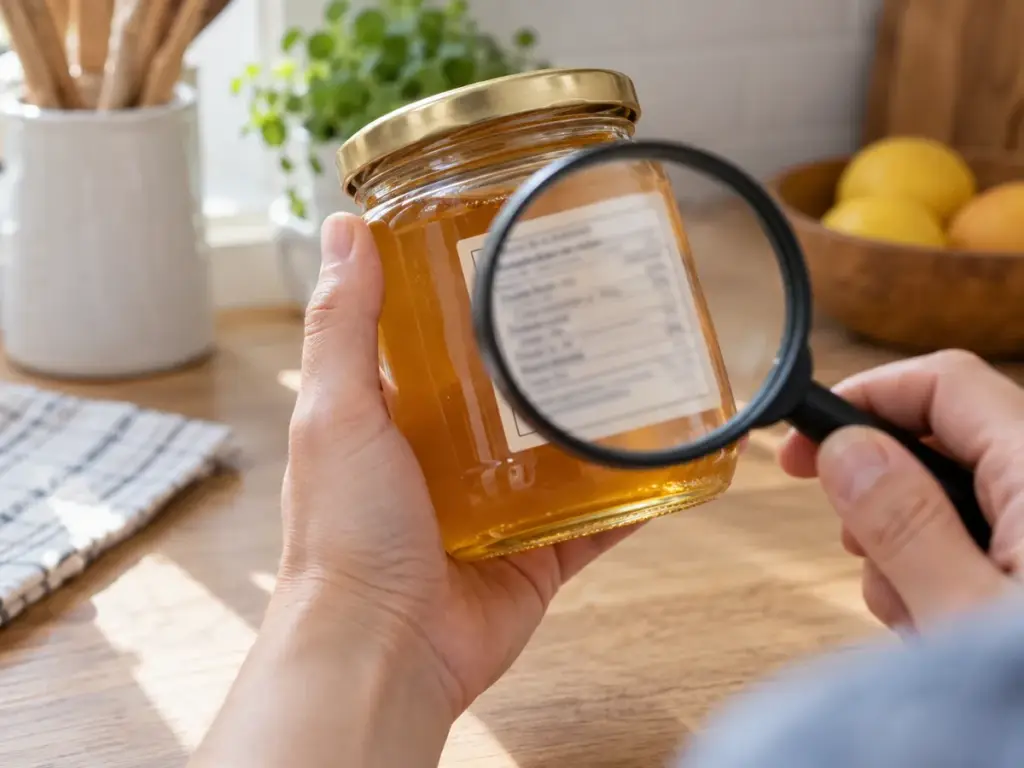
Honey contains small amounts of certain minerals and other compounds, but an everyday portion is not a practical way to meet vitamin or mineral needs. When reading a label, compare the per 100 g values with the amount you use. “Natural” does not mean “sugar-free” or “calorie-free.” For more on the differences between varieties, read about acacia honey and wildflower honey. Colour and flavour alone do not reliably tell you the calorie content.
How does honey count toward daily sugar intake?
The World Health Organization includes sugars naturally present in honey in its definition of free sugars. WHO recommends keeping free sugars below 10% of daily energy intake, with potential further benefits below 5%. On a 2,000 kcal diet, those thresholds correspond to about 50 g and 25 g of total free sugars respectively. They are not separate allowances for honey: other sweeteners, sweets, syrups, and fruit juices also count.
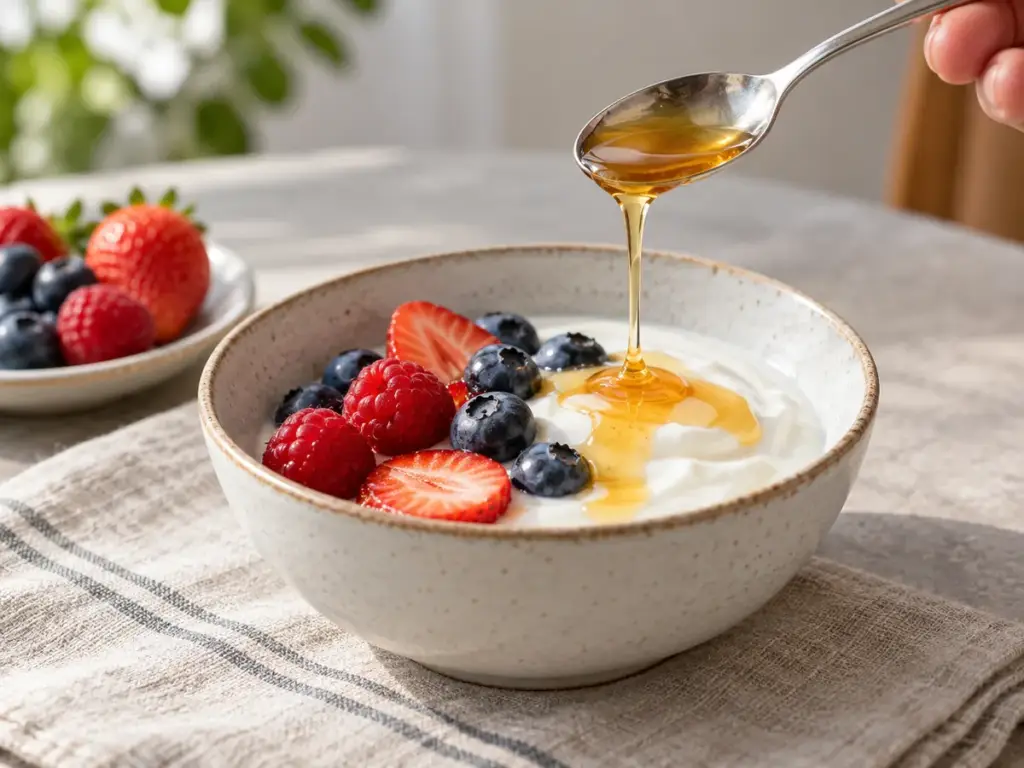
A weighed 7 g portion of honey provides approximately 5.8 g of carbohydrate, most of it sugar. Two such portions during a day should be considered alongside other sources of free sugars. If you add honey to tea or a honey, lemon, and ginger drink, start with a small amount and taste before adding more.
How can you measure honey more accurately?
Weigh the amount held by your usual level teaspoon a few times. This shows what your serving actually weighs, instead of relying on a vague “one spoonful.” If honey sticks to the spoon, weigh the bowl before and after adding it. Remember honey in yogurt, porridge, dressings, and drinks; several small amounts can add up during the day.
For recipes, use an amount that suits the dish and your taste. Honey is not a necessary addition to every meal. Substituting it for granulated sugar in baking can also change moisture and flavour. Our separate guide to using honey instead of sugar covers that comparison.
Who should pay particular attention?
If you count carbohydrates as part of diabetes care, include honey in your meal plan according to advice from your healthcare team. The USDA figures above offer a starting point for calculating the carbohydrate in a weighed portion. Honey is not a sweetener that can be left out of carbohydrate counting.
Never give honey to a child younger than 12 months. The CDC’s botulism prevention advice warns against it because of the risk of infant botulism, including honey mixed into food or drink. For older children and adults, consider the amount in the context of the whole diet rather than a universal rule about spoonfuls per day.
Frequently asked questions
Do different types of honey have different calorie counts?
Composition naturally varies. For a rough serving estimate, the weight and a particular product’s label are more helpful than the variety name. Do not assume dark or pale honey is automatically lower in calories.
Does “no added sugar” mean honey is sugar-free?
No. Pure honey does not need sugar added to taste sweet, but it naturally contains sugars. WHO counts those sugars as free sugars when considering overall intake.
How much honey per day is allowed?
There is no single recommended daily serving of honey for everyone. Consider all sources of free sugars, the rest of your diet, and any personal health needs. The WHO percentages refer to total free sugars, not honey alone.
Conclusion
For a quick estimate, remember about 304 kcal per 100 g, or roughly 3 kcal per gram. A small weighed serving may fit into a meal, but honey still contributes to free sugars. A kitchen scale and the product label provide a better answer than a guess based on spoon size.