Bee pollen is commonly sold as granules, but there is more to check before use than whether a product is “natural.” The label, processing and storage conditions matter, as do allergies and any medicines you take. Adding pollen to a meal does not remove these risks.
This guide explains how to distinguish products, read their instructions and handle granules sensibly. It does not recommend bee pollen as a treatment or set one daily amount for every reader.
Contents
What is bee pollen, and how does it differ from bee bread?
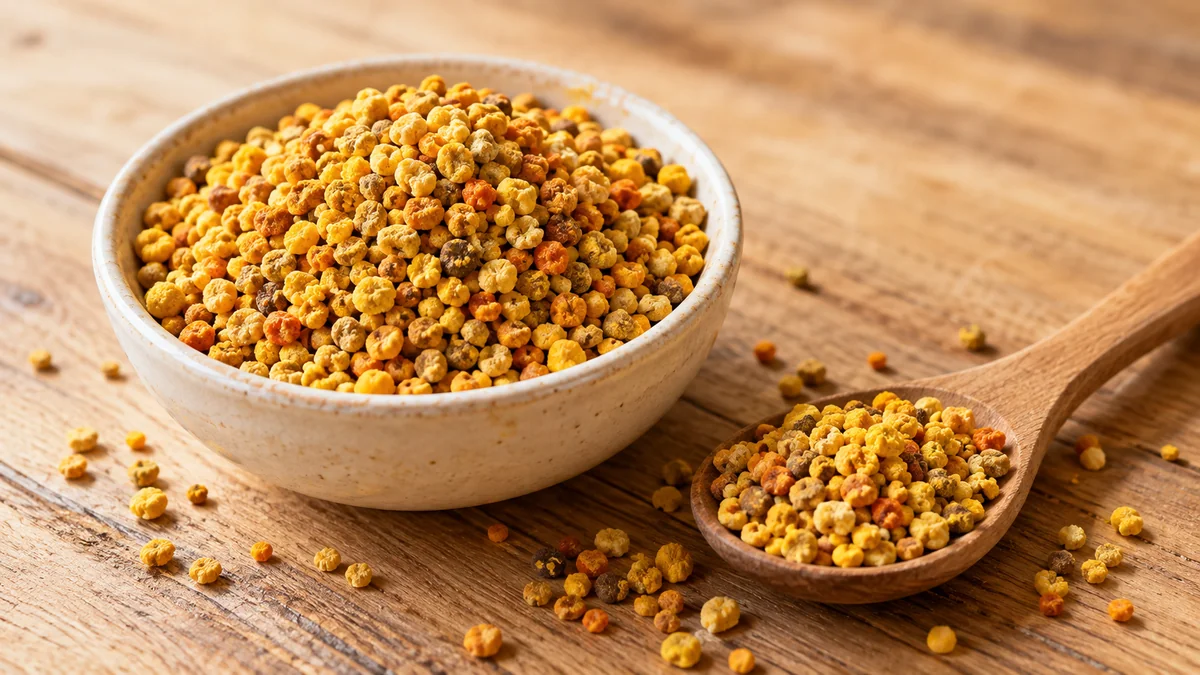
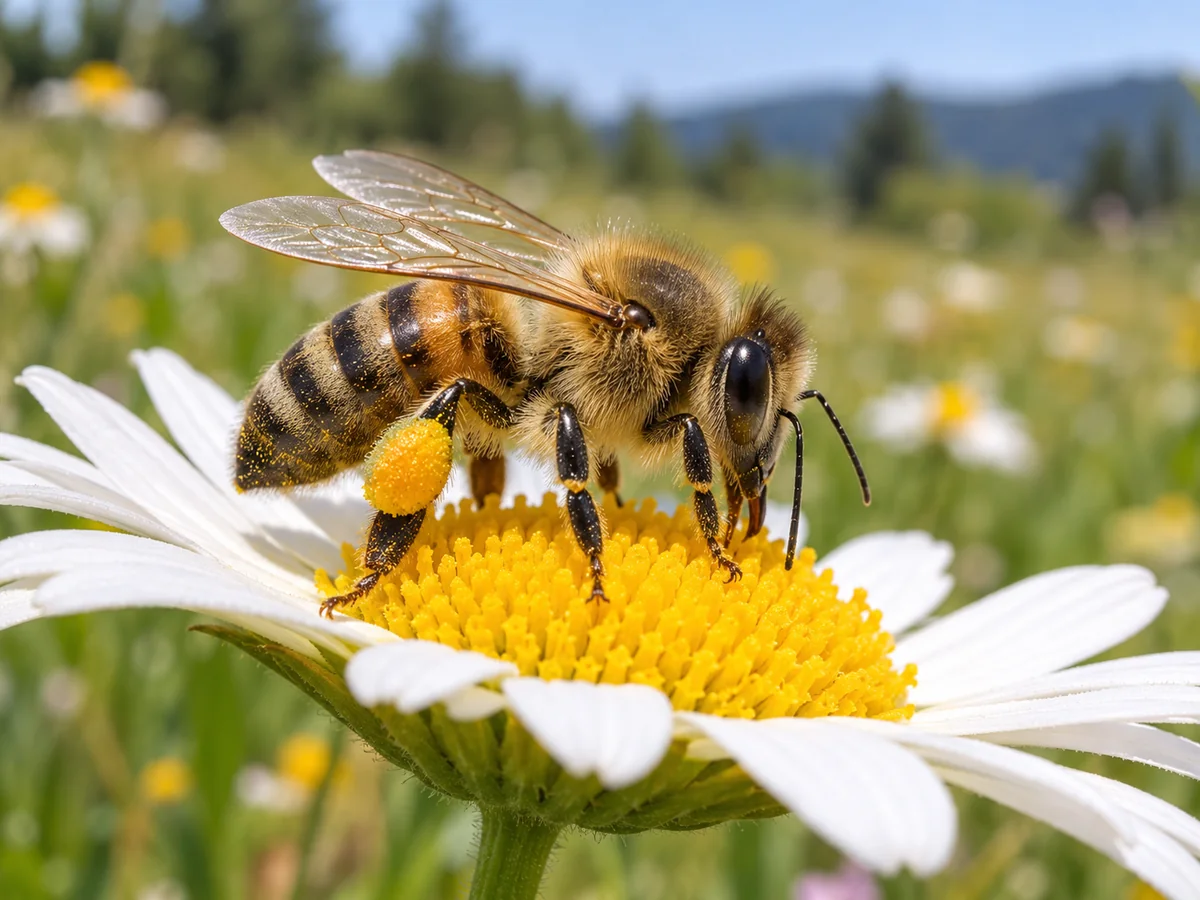
Bees collect pollen from flowers, moisten it with nectar or honey and form pellets carried on their hind legs. The collected product therefore looks like small granules. Their colour varies with the plants from which the pollen comes. The FAO guide to pollen and bee products explains this process and differences in composition.
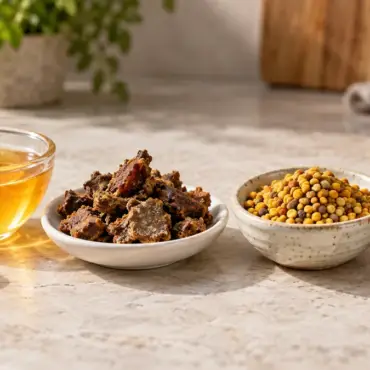
Bee bread, also called perga, develops from pollen that bees store and process in the comb. Granules collected in a pollen trap and bee bread are different products. An extract capsule is not automatically equivalent to a particular number of teaspoons of granules, either.
Pollen should also be distinguished from propolis. Propolis is a different material used by bees in the hive; our guide explains what propolis is and how bees make it. For a broader view of their work, read how honey is made.
Nutritional composition is not proof of a health benefit
Bee pollen contains proteins, fats, sugars and other constituents, but their proportions vary. Research on the composition of pollen samples illustrates why findings need to be tied to particular origins and samples. A list of vitamins or amino acids does not tell you how much your portion supplies. Ask for information about the specific product rather than applying internet averages to every jar.
In a review of clinical evidence on pollen, the authors describe the evidence for bee pollen’s therapeutic effectiveness as too limited to draw conclusions. They also distinguish bee pollen from particular flower-pollen extracts studied for specific purposes.
A result for a standardised extract therefore cannot simply be transferred to loose granules. Laboratory research does not establish that adding the same substance to a meal treats illness in people. Pollen should not be presented as a remedy for anaemia, infertility or infections, or as an essential supplement “for immunity.”
If tiredness, weakness or other persistent symptoms are the reason for buying a supplement, seek an explanation for those symptoms first. Choosing a supplement should not delay medical assessment. Regular meals and prescribed treatment should not be replaced because a package says “superfood.”
What to check on the label before buying
Clear product information is more useful than an attractive picture of a hive. Look for:
- the name and ingredients: pure pollen or a blend with honey and other ingredients;
- the form: dried granules, fresh or frozen pollen, capsules or an extract;
- the producer, batch number, expiry date and whether the packaging is sealed;
- directions for use, warnings and storage conditions;
- any instructions that apply after opening.
If the seller cannot explain how the product was processed or how it should be stored, do not guess from its appearance. Different granule colours do not, by themselves, establish better composition or poor quality. A photograph cannot confirm microbiological safety, either.
Read the entire label on a blend. A large word “pollen” on the front does not reveal its proportion, other ingredients or warnings. Keep the packaging information if you transfer the contents to another container, so that you can still check the batch and expiry date.
How to use bee pollen granules
Check whether the product is suitable for you before deciding how to serve it. If allergies, asthma, pregnancy, medicines or use by a child are involved, read the precautions section before adding it to food.
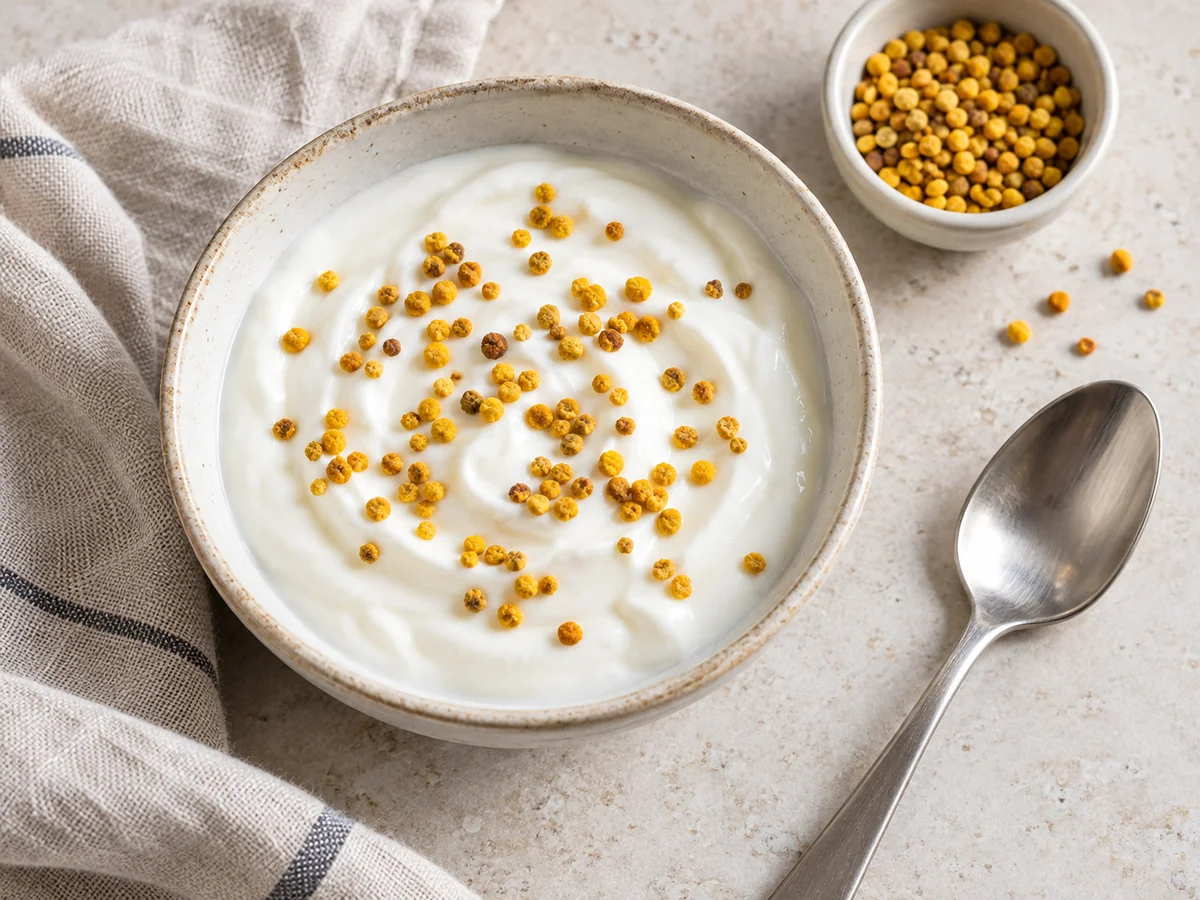
For a product intended for this use, granules can be mixed into yogurt or another meal according to the manufacturer’s directions. Use clean, dry utensils and prepare a portion you will eat. This is a serving method, not evidence of a therapeutic effect.
Is a particular daily amount necessary?
This guide does not prescribe a universal daily dose. Granules, capsules and blends differ in composition, and one producer’s directions are not a general recommendation for every product. If the label specifies grams, a kitchen scale gives a clearer measure than a heaped or level teaspoon.
Do not increase the amount on your own because you do not notice an “effect.” An absence of the hoped-for benefit is not a reason to turn a higher intake into treatment. If the instructions are unclear, ask the producer or a pharmacist to explain them.
Do the granules need to be soaked?
Follow any preparation instructions on the packaging. There is no basis for assigning the same soaking time or compulsory drink to every product. Soaking, grinding and mixing pollen with food should not be presented as methods that remove allergens.
In particular, do not leave a moist homemade mixture at room temperature for hours or days just because it contains pollen. The storage requirements of yogurt or another ingredient still apply. Directions for sealed, dry granules are not directions for a prepared meal.
Bee pollen with honey: what changes in a blend?
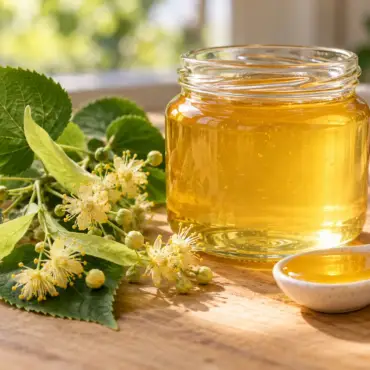
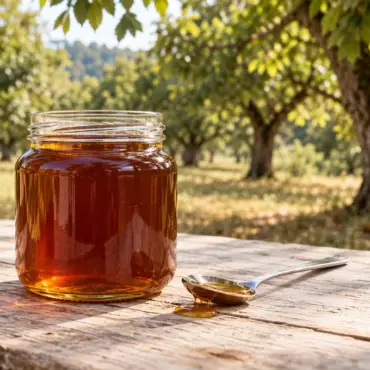
Adding honey changes the taste and composition of a meal. It does not turn pollen into a safer product or establish that the blend is a medicine. If pollen is unsuitable for you, mixing it with honey does not solve that problem.
For a ready-made product, check the ingredient proportions and directions for that particular blend. A teaspoon of pollen mixed with honey does not contain the same amount of pollen as a teaspoon of granules. Our guide to honey calories and nutrition can help you account for the sugars and energy supplied by added honey.
Do not invent a shelf life for a homemade mixture based on how long pure honey can last. If you want to add ingredients to a meal, preparing one portion is more practical than making a large jar without a validated recipe and storage conditions.
Who should avoid pollen or seek professional advice?
Pollen allergies and asthma
ANSES warns about allergic reactions associated with supplements containing pollen and hive products. It advises people with pollen allergies, a predisposition to allergies or asthma to avoid these supplements. Collection by bees does not make pollen free of allergens.
Do not try to “get used to” pollen at home by taking a few granules. This does not replace an allergy assessment. If you have already reacted to a product, stop using it and show its packaging to a healthcare professional.
Medicines, pregnancy, breastfeeding and children
For warfarin, there is a published case report of a probable interaction with bee pollen involving an increased INR. This does not establish how often the interaction occurs, but it is a reason not to introduce pollen while taking that medicine without professional advice. Do not change your prescribed dose yourself.
NCCIH notes that many supplements have not been studied in pregnant or breastfeeding women or in children, and that supplements can interact with medicines. Do not independently introduce pollen as a supplement in these groups. A child’s amount cannot be calculated simply by dividing an adult recommendation.
When emergency help is needed
Sudden swelling of the tongue or throat, difficulty breathing or swallowing, severe dizziness or loss of consciousness can indicate a serious allergic reaction. The NHS describes these signs of anaphylaxis, which requires emergency treatment. Call your local emergency service immediately; do not wait for symptoms to pass or take more of the product to “test” the reaction.
How to store bee pollen
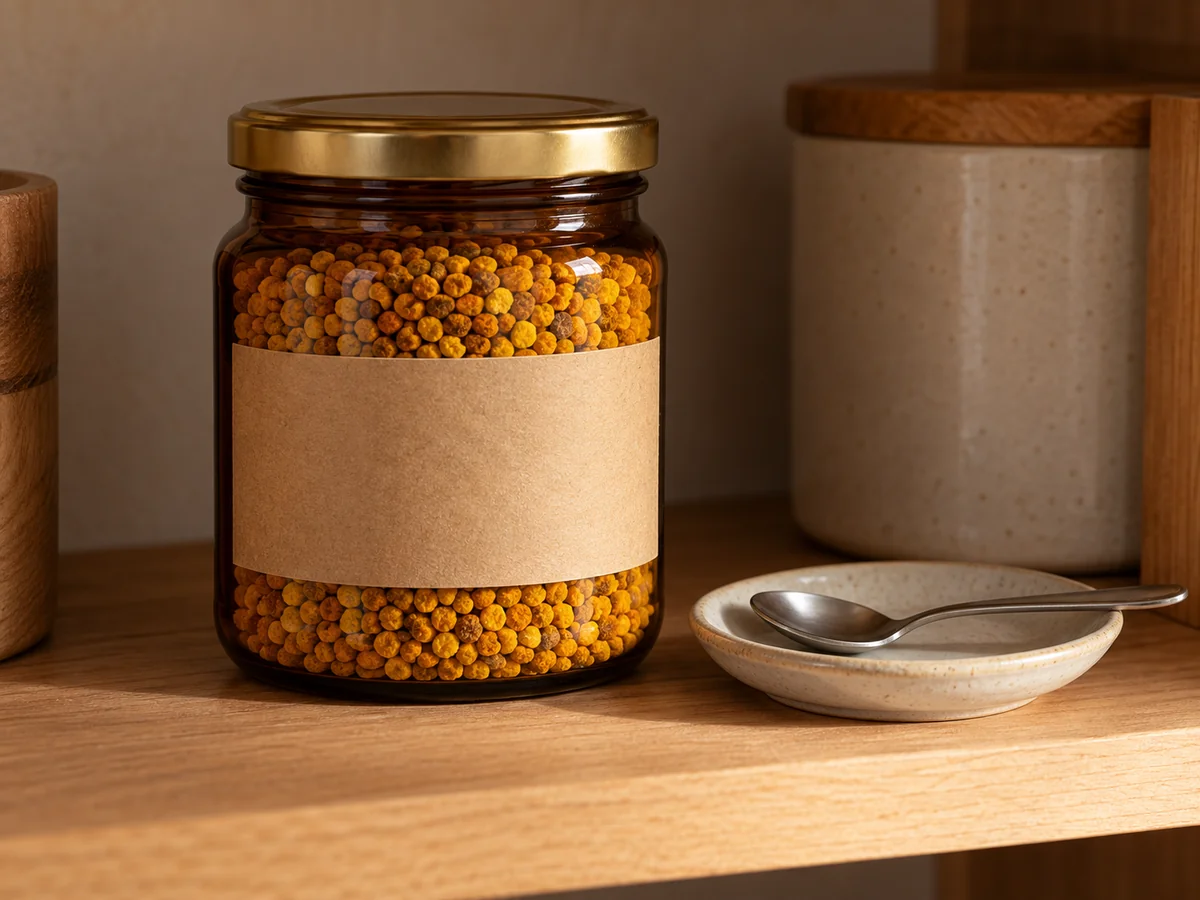
Storage conditions depend on the form of the product. Dried granules should not be treated in the same way as fresh or frozen pollen. Follow the label for temperature, storage location and the period after opening. If chilled or frozen storage is required, check how those conditions are maintained during transport, too.
Research on pollen drying and storage shows that processing and storage time affect particular constituents. Such findings do not set a universal shelf life for every jar. Follow the manufacturer’s conditions, including protection from light and moisture.
Use clean, dry utensils for dry granules and close the package after taking some out. Do not put a wet spoon from yogurt back into the jar. Do not add a new pack to the remains of an old one without retaining the batch and expiry information.
Do not use a product if you notice mould, moisture or an unusual smell. An absence of visible changes still does not confirm safety, especially when the origin or transport conditions are unknown. Mixing the product with honey or removing only the surface layer does not solve that problem.
Frequently asked questions
Does bee pollen help with seasonal allergies?
Do not use it as a home treatment for allergies. People allergic to pollen may also react to bee products. A specialist determines appropriate treatment and any immunotherapy; granules from a jar do not replace that process.
Can I take it throughout the year?
Do not introduce unlimited use just because a product is natural. ANSES advises against prolonged or repeated supplement use without professional advice. The reason for use, the product and your health matter more than a calendar routine.
Is pollen the same as honey mixed with pollen?
No. The amount of pollen in a blend depends on its proportion, while honey adds sugars and energy. Read the ingredients and directions; the product name does not determine either a suitable portion or whether it is appropriate for you.
Can I judge granule quality by appearance?
Appearance may reveal some visible problems, but it does not establish composition, an absence of contamination or correct storage. Reliable origin, batch details and label information are more useful than colour alone.
A choice that starts with the label
Treat bee pollen as a specific product with its own composition and directions. Check the precautions first, then serving and storage instructions. More granules do not mean greater benefit, and adding honey does not remove the risk of an allergic reaction.